
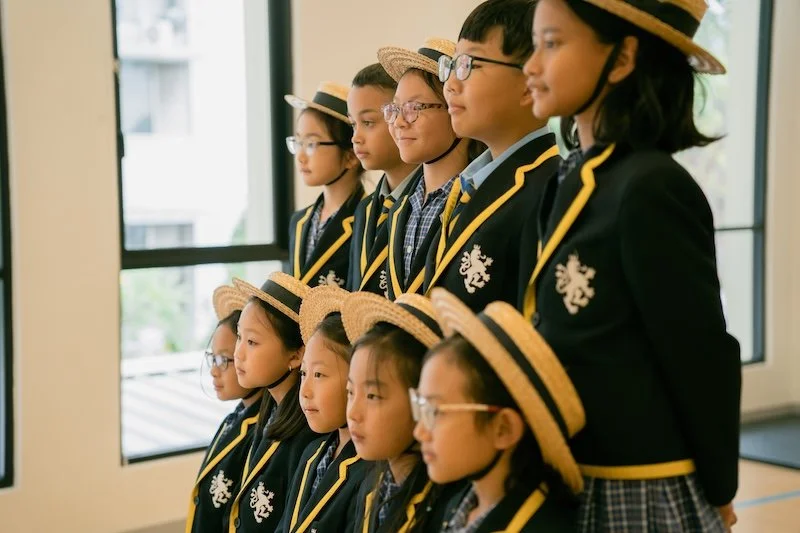
Far more than a music lesson, singing is a teaching method. At ISJ, it is woven throughout the curriculum to support memory, language, confidence, and creativity across every subject from the Early Years through to Year 8.
Grace Wang, who leads music at ISJ, puts it plainly: "When children sing, they connect the emotional and the intellectual. It makes the learning experience more vivid and easier to hold onto."
Building Language and Literacy
Singing plays a significant role in developing children's language skills. Through songs, pupils practise pronunciation, rhythm, and intonation, key foundations for fluent reading and confident speaking. Lyrics expose children to rich vocabulary and sentence structures in a way that feels natural.
For pupils learning English as an Additional Language, singing offers a particularly effective gateway into new sounds and words. Repeating language in melody builds confidence and familiarity without the pressure of formal conversation. The patterns of song make unfamiliar words feel approachable, even enjoyable.
Strengthening Memory and Understanding
Melody and rhythm help children remember information more effectively. Whether pupils are learning multiplication facts, scientific vocabulary, or the sequence of historical events, songs provide structure and repetition in a way that feels like play rather than drill.
"Music locks information into place," Grace Wang notes. "A child might forget a spoken fact, but they rarely forget the words to a song." The Arts and Music programme at ISJ reflects this belief across every year group.
This is not simply anecdote. The English National Curriculum describes music as "a universal language that embodies one of the highest forms of creativity," and cognitive research consistently shows that information attached to melody is retained for longer. ISJ uses this deliberately: songs are chosen and written to reinforce specific curriculum content, not just to fill time.
Singing Across Subjects
The approach is intentional and cross-curricular. At ISJ, singing appears across the timetable in the following ways:
- History: songs help children explore different periods, cultures, and chronologies
- Science: melodies reinforce understanding of processes and scientific vocabulary
- Mathematics: rhythm supports number patterns, times tables, and recall
- Geography: songs strengthen knowledge of locations and physical features
- English: performance develops diction, projection, and expressive reading
These connections make lessons more memorable and give children multiple entry points into the same material.
Boosting Confidence and Wellbeing
Pupil wellbeing runs through ISJ's daily practice, and singing contributes meaningfully to it. Singing releases endorphins, reduces stress, and creates a shared sense of belonging. It gives children a structured way to express themselves and to experience the satisfaction of performance, whether in front of their class or in a formal concert setting.
Assemblies, Family Fridays, and concerts give pupils regular, progressive opportunities to perform. Over time, this builds the ability to stand in front of others, speak or sing clearly, and take creative risks in a supportive environment.
For children who may find formal academic tasks challenging, singing often provides an alternative route to confidence. A pupil who hesitates during reading might carry a lyric perfectly in front of a full hall. That experience matters.
Encouraging Teamwork and Community
Singing is inherently collaborative. In choir rehearsals, class songs, and whole-school performances, children must listen carefully to one another, adjust their volume, and find their place within the group. These moments develop active listening, cooperation, and empathy that extend well beyond the music lesson.
Through shared performance, pupils learn the value of contributing to something larger than themselves, supporting each other, and celebrating collective effort rather than individual success alone.
A Thread Through the School
Singing sits at the heart of ISJ's creative, child-centred approach to learning. It reflects a belief that learning should be connected: intellectually, emotionally, and socially. When children sing, they are not simply rehearsing information. They are building habits of attention, expression, and collaboration that serve them across every part of school life. This begins in the Pre-Prep, where music, song, and rhythm are woven through the earliest years of learning.
The English National Curriculum makes clear that creativity is essential to every child's development and success. When children sing, they do not just learn information. They remember how it felt to discover it. That kind of learning lasts.