
EYFS stands for Early Years Foundation Stage. It is the statutory framework that sets the standards for learning, development, and care for children from birth to five in England. British international schools that follow the English National Curriculum use it as the foundation for their early years programmes.
At ISJ, the EYFS covers Pre-Nursery (age 2+), Nursery (age 3+), and Reception (age 4+), all within the Pre-Prep. By the end of Reception, children are assessed against the Early Learning Goals and are ready to begin Year 1 and the formal national curriculum.
The Seven Areas of Learning
The EYFS organises learning into seven areas, split into two groups.
The three prime areas are the foundation for everything else:
- Communication and Language. Listening, understanding, and speaking. Children learn to express ideas, follow instructions, and hold conversations.
- Physical Development. Fine and gross motor skills. Pencil grip, cutting, running, climbing, balancing.
- Personal, Social, and Emotional Development. Confidence, self-regulation, making relationships. Learning to share, take turns, manage feelings, and play cooperatively.
The four specific areas build on the prime areas:
- Literacy. From mark-making to reading and writing simple sentences. Phonics is the primary method for teaching reading.
- Mathematics. Counting, recognising numbers, simple addition and subtraction, shapes, patterns, and measurement.
- Understanding the World. People, communities, the natural world, and technology. Children explore through observation, questioning, and direct experience.
- Expressive Arts and Design. Drawing, painting, music, dance, role play, and imaginative storytelling.
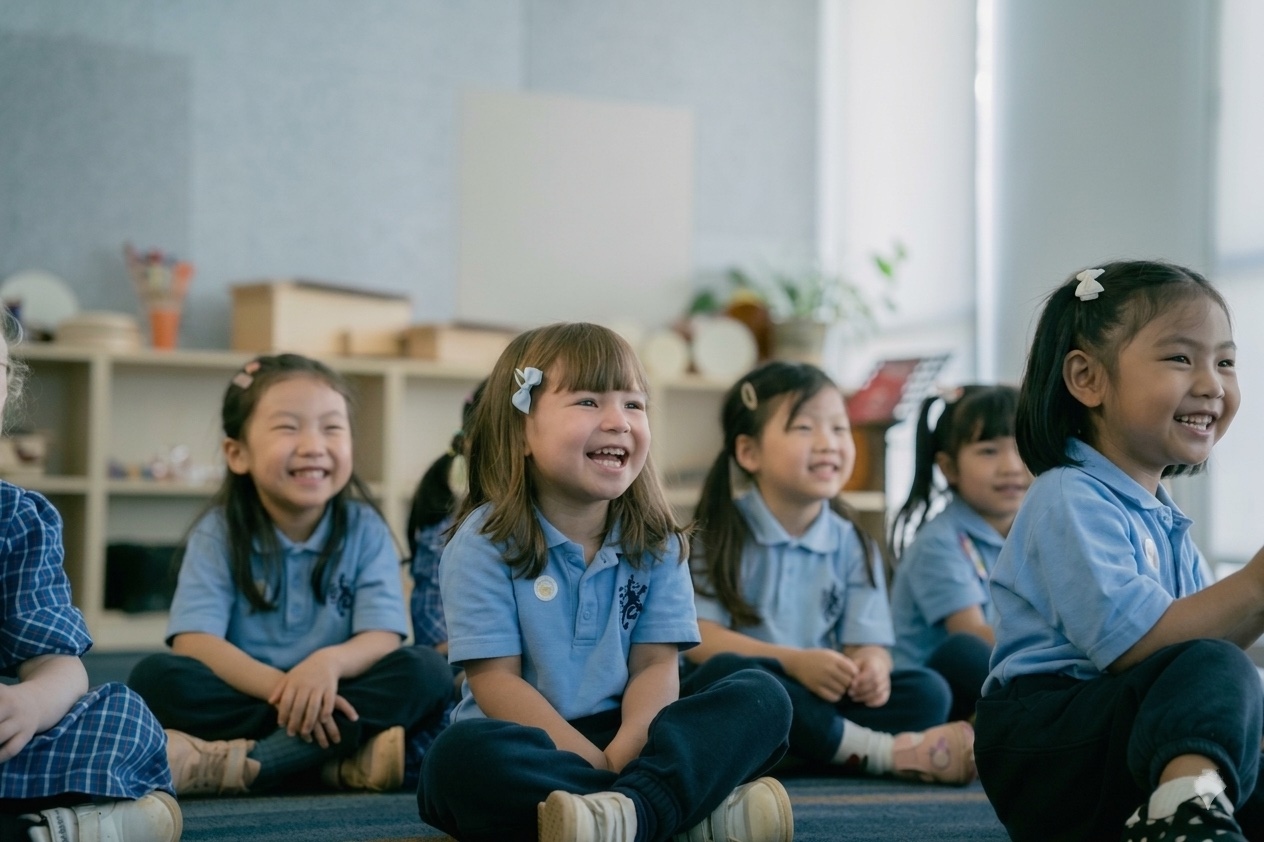
How Children Learn in EYFS
The EYFS recognises three characteristics of effective learning: playing and exploring, active learning, and creating and thinking critically. In practice, this means a balance of child-initiated activity (choosing what to explore) and adult-led teaching (structured lessons and guided activities).
A typical morning at ISJ might include a phonics session, free-flow play in the outdoor area, a guided mathematics activity, and a story. The balance shifts as children progress. Pre-Nursery is heavily play-based. By Reception, more structured teaching is introduced, preparing children for the transition to Year 1.
Assessment
Assessment in EYFS is primarily observational. Teachers watch how children play, interact, and respond. They record evidence against the seven areas of learning and use this to plan next steps.
Two formal assessment points exist. The Reception Baseline Assessment is completed within the first six weeks of Reception. The EYFS Profile is completed at the end of Reception and assesses each child against the 17 Early Learning Goals. Children are judged as either "meeting" or "not yet meeting" each goal.
These assessments are shared with parents. They also transfer with the child if the family moves to another British curriculum school.
What "School Readiness" Means
By the end of the EYFS, a child who is ready for Year 1 can typically: hold a pencil correctly and write some letters, read simple words using phonics, count reliably to 20, sit and listen during group activities, manage their own coat and bag, play cooperatively, and follow classroom routines.
Every child develops at a different pace. The EYFS is designed to accommodate that. A child who is not yet meeting a particular goal is not "behind." The framework tracks progress over time, and teachers adjust their approach accordingly.
EYFS at ISJ
At ISJ, the EYFS programme includes specialist teaching in music, art, drama, PE, swimming, Bahasa Indonesia, and Mandarin Chinese alongside the core framework. Classes are up to 15 children in Early Years, with a staff-to-child ratio of 1:5 in the youngest classes.
The Pre-Prep team is led by James Johnston, Head of Early Years, who holds a PGCE with an Early Years specialism and is currently studying for a Masters in Special and Inclusive Education. Families wanting to understand how the EYFS fits into the broader British curriculum can find an overview in the English National Curriculum guide.